
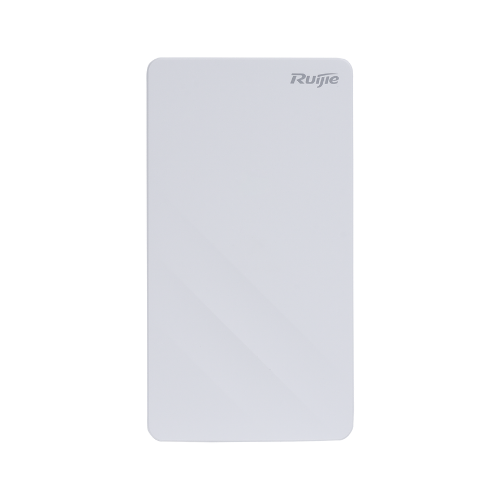

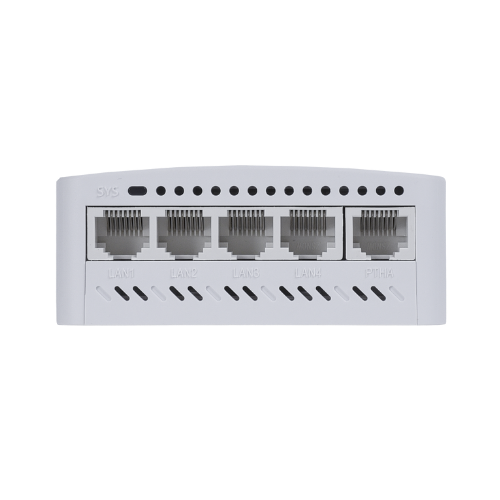
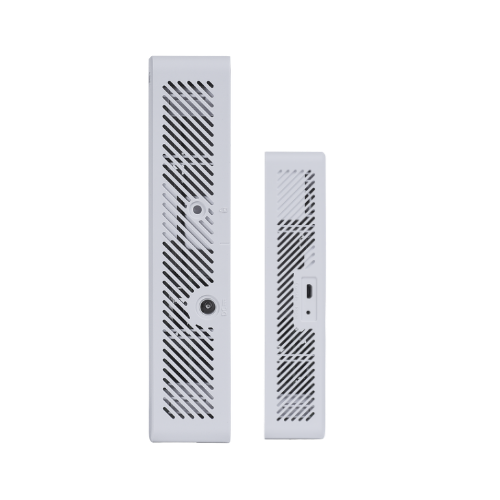
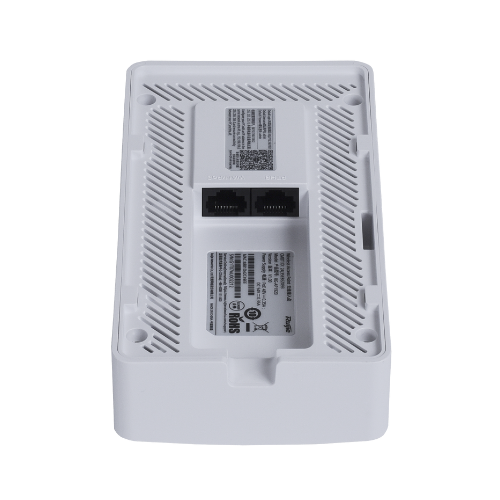
Key Specification
| Wireless Protocols | 802.11n/ac/ax/be | Radio design | Dual-radio: 2.4 GHz (2×2), 5 GHz (2×2), up to 4 spatial streams | |
| Max. data transmission rate | 3.570 Gbps | Wi-Fi antenna | Built-in omnidirectional smart antenna | |
| Fixed service port | 1 x 100/1000/2.5GBASE-T port
4 x 10/100/1000BASE-T ports 1 x a pair of pass-through ports |
Bluetooth | Bluetooth 5.3 | |
| Max. number of associated STAs | 256 (128 STAs per radio) | Input power supply | 54 V DC/0.35 A power input over DC connector;
PoE/PoE+ input, in compliance with IEEE 802.3af/at |
|
| Max. power consumption | 16.8 W | Operating temperature | –10°C to +40°C (14°F to 104°F) | |
| Dimensions (W x H x D) | 86 mm x 160 mm x 35 mm | Mounting | 86 mm junction box or wall | |
Specifications
Hardware Specifications
| Hardware Specifications | RG-AP1920 |
| 802.11n | 4 spatial streams
● Radio 1 – 2.4 GHz: 2×2 MIMO, two spatial streams ● Radio 2 – 5 GHz: 2×2 MIMO, two spatial streams Channel: ● Radio 1 – 2.4 GHz: 20 MHz and 40 MHz ● Radio 2 – 5 GHz: 20 MHz and 40 MHz Combined peak data rate: 600 Mbps ● Radio 1 – 2.4 GHz: 6.5 Mbps to 300 Mbps (MCS0 to MCS15) ● Radio 2 – 5 GHz: 6.5 Mbps to 300 Mbps (MCS0 to MCS15) Radio technologies: Orthogonal Frequency-Division Multiplexing (OFDM) Modulation types: BPSK, QPSK, 16-QAM and 64-QAM Packet aggregation: ● Aggregate MAC Protocol Data Unit (A-MPDU) ● Aggregate MAC Service Data Unit (A-MSDU) Dynamic Frequency Selection (DFS) Cyclic Delay/Shift Diversity (CDD/CSD) Maximum Ratio Combining (MRC) Space-Time Block Coding (STBC) Low-Density Parity Check (LDPC) Transmit beam-forming (TxBF) |
| 802.11ac | 2 spatial streams
● Radio 2 – 5 GHz: 2×2 MIMO, two spatial streams Channel: ● Radio 2 – 5 GHz: 20 MHz, 40 MHz, 80 MHz and 160 MHz Combined peak data rate: 1.733 Gbps ● Radio 2 – 5 GHz: 6.5 Mbps to 1.733 Gbps (MCS0 to MCS9) Radio technologies: Orthogonal Frequency-Division Multiplexing (OFDM) Modulation types: BPSK, QPSK, 16-QAM, 64-QAM and 256-QAM Packet aggregation: ● Aggregate MAC Protocol Data Unit (A-MPDU) ● Aggregate MAC Service Data Unit (A-MSDU) Dynamic Frequency Selection (DFS) Cyclic Delay/Shift Diversity (CDD/CSD) Maximum Ratio Combining (MRC) Space-Time Block Coding (STBC) Low-Density Parity Check (LDPC) Transmit beam-forming (TxBF) |
| 802.11ax | 4 spatial streams
● Radio 1 – 2.4 GHz: 2×2 MIMO, two spatial streams ● Radio 2 – 5 GHz: 2×2 MIMO, two spatial streams Channel: ● Radio 1 – 2.4 GHz: 20 MHz and 40 MHz ● Radio 2 – 5 GHz: 20 MHz, 40 MHz, 80 MHz and 160 MHz Combined peak data rate: 2.976 Gbps ● Radio 1 – 2.4 GHz: 7.3 Mbps to 0.574 Gbps (MCS0 to MCS11) ● Radio 2 – 5 GHz: 7.3 Mbps to 2.402 Gbps (MCS0 to MCS11) Radio technologies: uplink/downlink Orthogonal Frequency-Division Multiple Access (OFDMA) Modulation types: BPSK, QPSK, 16-QAM, 64-QAM, 256-QAM and 1024-QAM Packet aggregation: ● Aggregate MAC Protocol Data Unit (A-MPDU) ● Aggregate MAC Service Data Unit (A-MSDU) Dynamic Frequency Selection (DFS) Cyclic Delay/Shift Diversity (CDD/CSD) Maximum Ratio Combining (MRC) Space-Time Block Coding (STBC) Low-Density Parity Check (LDPC) Transmit beam-forming (TxBF) WPA3 |
| 802.11be | 4 spatial streams
● Radio 1 – 2.4 GHz: 2×2 MIMO, two spatial streams ● Radio 2 – 5 GHz: 2×2 MIMO, two spatial streams Channel: ● Radio 1 – 2.4 GHz: 20 MHz and 40 MHz ● Radio 2 – 5 GHz: 20 MHz, 40 MHz, 80 MHz and 160 MHz Combined peak data rate: 3.570 Gbps ● Radio 1 – 2.4 GHz: 7.3 Mbps to 0.688 Gbps (MCS0 to MCS13) ● Radio 2 – 5 GHz: 7.3 Mbps to 2.882 Gbps (MCS0 to MCS13) Radio technologies: uplink/downlink Orthogonal Frequency-Division Multiple Access (OFDMA) Modulation types: BPSK, QPSK, 16-QAM, 64-QAM, 256-QAM, 1024-QAM and 4096-QAM Packet aggregation: ● Aggregate MAC Protocol Data Unit (A-MPDU) ● Aggregate MAC Service Data Unit (A-MSDU) Dynamic Frequency Selection (DFS) Cyclic Delay/Shift Diversity (CDD/CSD) Maximum Ratio Combining (MRC) Space-Time Block Coding (STBC) Low-Density Parity Check (LDPC) Transmit beam-forming (TxBF) WPA3 |
| Antenna | Wi-Fi
● 2.4 GHz: two built-in omnidirectional smart antennas, with peak antenna gain of 3 dBi. ● 5 GHz: two built-in omnidirectional smart antennas, with peak antenna gain of 3 dBi. Bluetooth ● One built-in omnidirectional antenna, with peak antenna gain of 2.5 dBi. |
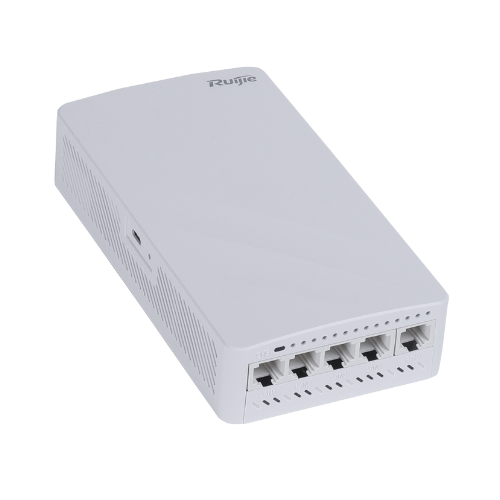
| Port | 1 x 100/1000/2.5GBASE-T port
4 x 10/100/1000BASE-T ports 1 x micro USB console port 1 x a pair of pass-through ports 1 x Bluetooth 5.3 |
| Status LED | 1 x system status LED
● AP power-on status ● Software initialization status and upgrade status ● Uplink service interface status ● Wireless user online status ● CAPWAP tunnel timeout ● Specific AP locating |
| Button | 1 x Reset button
● Press the button for shorter than 2 seconds. Then the device restarts. ● Press the button for longer than 5 seconds. Then the device restores to factory settings. |
| Dimensions (W x H x D) | Main unit: 86 mm x 160 mm x 35 mm (3.39 in. x 6.30 in. x 1.38 in.)
Shipping: 347 mm x 383 mm x 270 mm (13.66 in. x 15.08 in. x 10.63 in.) |
| Weight | Main unit: 0.3 kg (0.66 lbs)
Mounting bracket: 0.05 kg (0.11 lbs) Shipping: 9.73 kg (21.45 lbs) |
| Mounting | 86 mm junction box-mount or wall-mount |
| Lock option | Kensington lock |
| Input power supply | The AP supports the following power supply modes:
● 54 V DC/0.35 A power input over DC connector ● PoE/PoE+ input, in compliance with IEEE 802.3af/at standard Note: ● If both DC power and PoE are available, DC power is preferred. ● When the AP adopts DC power supply, an adapter with a power of less than 100 W should be used. |
| Maximum power consumption | Maximum power consumption: 16.8 W
● DC power: 16.8 W, 2.4 GHz radio 2×2, 5 GHz radio 2×2 ● 802.3at (PoE+): 16.8 W, 2.4 GHz radio 2×2, 5 GHz radio 2×2 ● 3af (PoE): 12.68 W, 2.4 GHz radio 2×2, 5 GHz radio 2×2(Note: The maximum channel widths in the 2.4 GHz and 5 GHz frequency bands are reduced to 20 MHz and 40 MHz respectively.) ● Idle mode: 7.2 W |
| Environment | Storage temperature: –40°C to +70°C (–40°F to +158°F)
Storage humidity: 5% RH to 95% RH (non-condensing) Storage altitude: –500 m to +5,000 m (–1640.42 ft. to +16,404.20 ft.) Operating temperature: –10°C to +40°C (14°F to 104°F) Operating humidity: 5% RH to 95% RH (non-condensing) Operating altitude: –500 m to +5,000 m (–1640.42 ft. to +16,404.20 ft.) Note: At an altitude in the range of 1,800–5,000 m (5,905.51–16,404.20 ft.), every time the altitude increases by 220 m (721.78 ft.), the maximum temperature decreases by 1°C (1.8°F). |
| Mean Time Between Failure (MTBF) | 200,000 hours (22 years) at the operating temperature of 25°C (77°F) |
| System memory | 512 MB, 256 MB flash |
| Transmit power | 2.4 GHz
● Maximum transmit power: 20 dBm (100 mW) ● Minimum transmit power: 0 dBm (1 mW) 5 GHz ● Maximum transmit power: 20 dBm (100 mW) ● Minimum transmit power: 0 dBm (1 mW) Note: ● Adjusting the transmit power by percentage (recommended) and in 1dBm increments. ● The transmit power is limited by local regulatory requirements. For details, see WLAN Country or Region Codes and Channel Compliance. |
The following table lists the radio frequency performance of Wi-Fi including different frequency bands, protocols, and data rates. It is country-specific, and Ruijie Networks reserves the right of interpretation.
| Wi-Fi Radio Performance | RG-AP1920 | ||
| Frequency Band and Protocol | Data Rate | Maximum Transmit Power per Transmit Chain | Maximum Receive Sensitivity per Receive Chain |
| 2.4 GHz 802.11g | 6 Mbps | 20 dBm | -91 dBm |
| 24 Mbps | 17 dBm | -85 dBm | |
| 36 Mbps | 17 dBm | -80 dBm | |
| 54 Mbps | 16 dBm | -74 dBm | |
| 2.4 GHz 802.11n (HT20) | MCS0 | 18 dBm | -85 dBm |
| MCS7 | 16 dBm | -67 dBm | |
| 2.4 GHz 802.11n (HT40) | MCS0 | 18 dBm | -82 dBm |
| MCS7 | 16 dBm | -64 dBm | |
| 2.4 GHz 802.11ax (HE20) | MCS0 | 18 dBm | -85 dBm |
| MCS11 | 14 dBm | -58 dBm | |
| 2.4 GHz 802.11ax (HE40) | MCS0 | 18 dBm | -82 dBm |
| MCS11 | 14 dBm | -54 dBm | |
| 2.4 GHz 802.11be (EHT40) | MCS0 | 18 dBm | -82 dBm |
| MCS11 | 14 dBm | -54 dBm | |
| 5 GHz 802.11a | 6 Mbps | 20 dBm | -91 dBm |
| 24 Mbps | 17 dBm | -85 dBm | |
| 36 Mbps | 17 dBm | -80 dBm | |
| 54 Mbps | 16 dBm | -74 dBm | |
| 5 GHz 802.11n (HT20) | MCS0 | 18 dBm | -85 dBm |
| MCS7 | 16 dBm | -67 dBm | |
| 5 GHz 802.11n (HT40) | MCS0 | 18 dBm | -82 dBm |
| MCS7 | 16 dBm | -64 dBm | |
| 5 GHz 802.11ac (VHT20) | MCS0 | 18 dBm | -85 dBm |
| MCS7 | 16 dBm | -67 dBm | |
| 5 GHz 802.11ac (VHT40) | MCS0 | 18 dBm | -82 dBm |
| MCS9 | 15 dBm | -57 dBm | |
| 5 GHz 802.11ac (VHT80) | MCS0 | 18 dBm | -82 dBm |
| MCS9 | 15 dBm | -56 dBm | |
| 5 GHz 802.11ax (HE20) | MCS0 | 18 dBm | -85 dBm |
| MCS11 | 14 dBm | -58 dBm | |
| 5 GHz 802.11ax (HE40) | MCS0 | 18 dBm | -82 dBm |
| MCS11 | 14 dBm | -54 dBm | |
| 5 GHz 802.11ax (HE80) | MCS0 | 18 dBm | -82 dBm |
| MCS9 | 15 dBm | -56 dBm | |
| MCS11 | 14 dBm | -52 dBm | |
| 5 GHz 802.11ax (HE160) | MCS0 | 18 dBm | -79 dBm |
| MCS9 | 15 dBm | -53 dBm | |
| MCS11 | 14 dBm | -50 dBm | |
| 5 GHz 802.11be (EHT80) | MCS0 | 18 dBm | -82 dBm |
| MCS9 | 15 dBm | -56 dBm | |
| MCS11 | 14 dBm | -52 dBm | |
| MCS13 | 12 dBm | -46 dBm | |
| 5 GHz 802.11be (EHT160) | MCS0 | 18 dBm | -79 dBm |
| MCS9 | 15 dBm | -53 dBm | |
| MCS11 | 14 dBm | -50 dBm | |
| MCS13 | 10 dBm | -44 dBm | |
Note: Available frequency bands may vary with countries or regions. To use the above-mentioned frequency bands, ensure that they are supported in your country or region. For details, see WLAN Country or Region Codes and Channel Compliance.
Software Specifications
| Basic Function | RG-AP1920 |
| Applicable software version | RGOS11.9(6)W3B19 or later |
| WLAN | |
| Maximum number of associated STAs | 256 (up to 128 STAs per radio) |
| Practical maximum client count indication (per device) | 64 |
| Maximum number of BSSIDs | 32 (up to 16 BSSIDs per radio) |
| Maximum number of WLAN IDs | 16 |
| STA management | SSID hiding
Band steering (preferential access to the 5 GHz radio) Each SSID can be configured with the authentication mode, encryption mechanism, and VLAN attributes independently. Remote intelligent perception technology (RIPT) Intelligent load balancing based on the STA quantity or traffic |
| STA limiting | SSID-based STA limiting
Radio-based STA limiting |
| Bandwidth limiting | STA/SSID/AP-based rate limiting |
| CAPWAP | IPv4/IPv6 CAPWAP
Layer 2 and Layer 3 topology between an AP and an AC An AP can automatically discover the accessible AC. An AP can be automatically upgraded through the AC. An AP can automatically download the configuration file from the AC. CAPWAP through NAT MTU setting and fragmentation over CAPWAP tunnels Encryption over CAPWAP data tunnels Encryption over CAPWAP control tunnels |
| Data forwarding | Centralized and local forwarding |
| Wireless roaming | Layer 2 and Layer 3 roaming |
| Wireless locating | Mobile unit (MU) location |
| Application management | Application identification |
| Security and Authentication | |
| Authentication and encryption | Remote Authentication Dial-In User Service (RADIUS)
EXEC authorization, specifying source IP addresses of RADIUS packets, supporting authentication of other vendors, and built-in authentication server PSK, Web, 802.1X, WPA, WPA2, and WPA3 authentication QR code-based guest authentication, SMS-based authentication, and MAC authentication bypass (MAB) Data encryption: WEP (64/128 bits), WPA-Personal, WPA-Enterprise, WPA2-Personal (PSK, TKIP, CCMP), WPA2-Enterprise, WPA3-Personal (SAE, WPA2/WPA3 transition mode), WPA3-Enterprise (CCMP, GCMP), WPA3-OWE |
| Data frame filtering | Allowlist, static blocklist, and dynamic blocklist |
| WIDS | Wireless Intrusion Detection System (WIDS)
User isolation Rogue AP detection and containment |
| Dynamic Policy | IP standard ACL, MAC extended ACL, IP extended ACL, expert ACL, and IPv6 ACL
Time range-based ACL ACL based on a Layer 2 interface ACL based on a Layer 3 interface Ingress ACL based on a wireless interface Dynamic ACL assignment based on 802.1X authentication (used with an AC) |
| CPP | CPU Protect Policy (CPP) |
| NFPP | Network Foundation Protection Policy (NFPP)
ARP attack defense, ICMP attack defense, and DHCP attack defense |
| Routing and Switching | |
| MAC | Static MAC address, MAC address filtering, MAC address limiting
MAC address table size: 1,024 Maximum number of static MAC addresses: 1,024 Maximum number of filtered MAC addresses: 1,024 |
| Ethernet | Jumbo frame length: 1,518
Full-duplex and half-duplex modes of interfaces Optical module information display, alarms about faults, and diagnosis parameter measurement (QSFP+/SFP+/SFP) |
| VLAN | Interface-based VLAN assignment
Maximum number of SVIs: 200 Maximum number of VLANs: 4,094 VLAN ID range: 1–4,094 |
| ARP | ARP entry aging, gratuitous ARP learning, and proxy ARP
Identification of IP address conflict among downlink users Maximum number of ARP entries: 1,024 ARP check |
| IPv4 services | Static IPv4 address and DHCP-assigned IPv4 address
Maximum number of IPv4 addresses configured on each Layer 3 interface: 200 NAT, FTP ALG, and DNS ALG |
| IPv6 services | IPv6 addressing, Neighbor Discovery (ND), IPv6 ND proxy, ICMPv6, and IPv6 ping
IPv6 DHCP client Maximum number of IPv6 addresses configured on each Layer 3 interface: 400 |
| IP routing | IPv4/IPv6 static route
Maximum number of static IPv4 routes: 1,024 Maximum number of static IPv6 routes: 1,000 |
| Multicast | Multicast-to-unicast conversion |
| VPN | PPPoE client
IPsec VPN |
| Network Management and Monitoring | |
| Network management | NTP server and NTP client
SNTP client SNMP v1/v2c/v3 Fault detection and alarming Information statistics collection and logging |
| Network management platform | Web management (Eweb) |
| User access management | Console, Telnet, SSH, FTP client, FTP server, and TFTP client |
| Switchover among Fat, Fit, and cloud modes | When the AP works in Fit mode, it can be switched to Fat mode through an AC.
When the AP works in Fat mode, it can be switched to Fit mode through the console port or Telnet. When the AP works in Cloud mode, it can be managed through WIS Cloud. |
Regulatory Compliance
| Regulatory Compliance | RG-AP1920 |
| Regulatory compliance | EN 55032, EN 55035, EN IEC 61000-3-2, EN 61000-3-3, EN 301 489-1, EN 301 489-3, EN 301 489-17, EN 300 328, EN 301 893, EN 300 440, EN IEC 62311, FCC Part 15, IEC 62368-1, EN 62368-1, EN 18031-1, and EN 18031-2 |
* For more country-specific regulatory information and approvals, contact your local sales agency.
Note:
- EU simplified DoC: Hereby, [Ruijie Networks Co., Ltd.] declares that the radio equipment type [RG-AP1920] is in compliance with Directive 2014/53/EU. The full text of the EU declaration of conformity is available at the following internet address: https://www.ruijie.com/.
- UK simplified DoC: Hereby, [Ruijie Networks Co., Ltd.] declares that the radio equipment type [RG-AP1920] is in compliance with UK Radio Equipment Regulation 2017. The full text of the UK declaration of conformity is available at the following internet address: https://www.ruijie.com/.
- The functions of Wireless Access Systems including Radio Local Area Networks(WAS/RLANs) within the band 5150-5350 MHz for this device are restricted to indoor use only within all European Union countries (BE/BG/CZ/DK/DE/EE/IE/EL/ES/FR/HR/IT/CY/LV/LT/LU/HU/MT/NL/ AT/PL/PT/RO/SI/SK/FI/SE/TR/NO/CH/IS/LI/UK(NI)
- Ruijie wireless products provide only secure and reliable network protocols and communication ports by default. For details, see Ruijie Default Protocols and Ports for Wireless Products. Proper firewall and security policies can be implemented based on this document to ensure the normal operation of wireless services.
Order Information
| Model | Description |
| RG-AP1920 | Wi-Fi 7 dual-radio wall plate access point
Up to four spatial streams, peak data rate of 3.570 Gbps ● Radio 1: 2.4 GHz: two spatial streams, 2×2 MIMO, peak data rate of 0.688 Gbps ● Radio 2: 5 GHz: two spatial streams,2×2 MIMO, peak data rate of 2.882 Gbps The AP consumes 0.5 licenses of an AC. 802.11a/b/g/n/ac/ax/be, switching between Fat, Fit, and cloud modes, and 802.3af/at-compliant (PoE/PoE+) and local power supply Note: ● The DC power supply needs to be purchased separately, and the output voltage/current must be 50 V/0.35 A. ● When the AP adopts DC power supply, an adapter with a power of less than 100 W should be used. |