
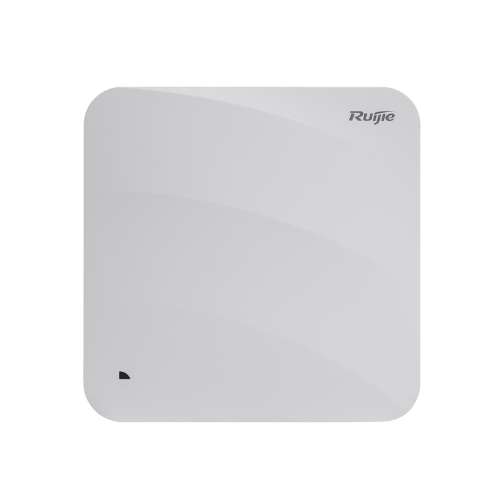


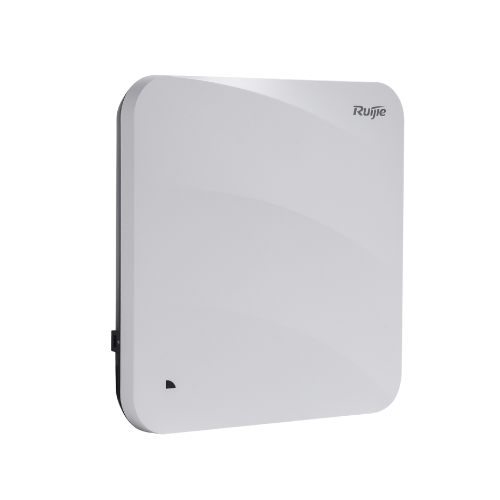
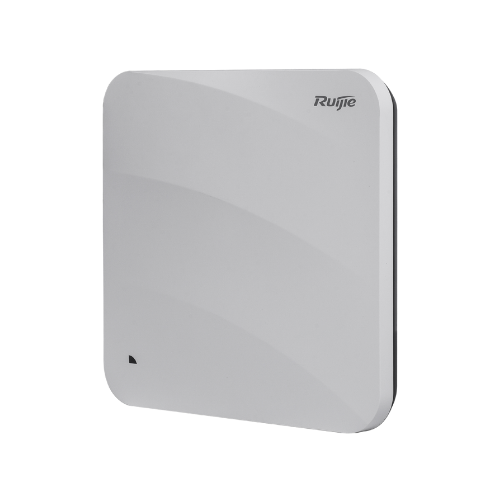
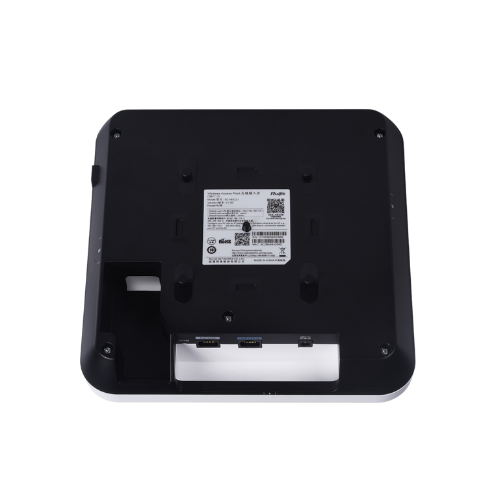
Key Specification
| Wireless Protocols | 802.11a/b/g/n/ac/ax | Radio Design | Dual-radio: 2.4 GHz (2×2), 5 GHz (2×2),up to 4 spatial streams | |
| Data Rate | Combined peak data rate: 2.4 GHz + 5 GHz, 1.775 Gbps | Antenna Type | Built-in omnidirectional antennas | |
| Fixed Service Port | 1 x 10/100/1000Base-T port | Bluetooth | Bluetooth 5.1 | |
| Input Power Supply | 48 V DC/0.3 A power supply
PoE (802.3af) |
Max. Power Consumption | 12.95 W | |
| External Power Supply | No | Operating Temperature | –10°C to +50°C (14°F to 122°F) | |
| IP Rating | N/A | Dimensions (W x D x H) | 220 mm x 220 mm x 49 mm (8.66 in. x 8.66 in. x 1.93 in.) | |
| Mounting | Wall/Ceiling mount | Warranty | 3 Years | |
Features
Product Overview
The RG-AP810-I is a Wi-Fi 6 wireless access point that integrates dual radios, high performance, and enterprise-grade encryption technology. Due to the hybrid cloud management mode and high-density access design, it is suitable for flexible deployment in high-quality network scenarios, such as classroom, dormitory, and office scenarios in the education industry, production workshop and warehouse scenarios in the manufacturing industry, outpatient clinics and mobile ward rounds scenarios in the medical industry, boutique hotels, and retail shops.
Product Highlights
Cost-effectiveness and High Speed
Dual-band design (2.4 GHz + 5 GHz), four spatial streams, 1024-Quadrature Amplitude Modulation (QAM) high-speed access, and up to 1.775 Gbps peak data rate, realizing high-speed wireless access experience
Orthogonal Frequency-Division Multiple Access (OFDMA), Multi-User Multiple-Input Multiple-Output (MU-MIMO), and Wi-Fi Multimedia (WMM), increasing the average rate per user in high-density deployment environments
RF power adjustment and intelligent channel allocation to solve the problems such as co-channel interference and adjacent channel interference, thereby improving network transmission efficiency and stability
Intelligent networking
Local and cloud management modes, and intelligent wireless network optimization, reducing TCO and maximizing ROI
Intelligent power monitoring, which monitors PoE output power and disables or enables some functions according to the available power to ensure normal operation of the AP
IEEE 802.11k/v/r support and roaming stickiness optimization, achieving seamless user roaming
Rich IoT features: PoE power, Bluetooth 5.1, support for iBeacon, and wireless locating
High Security and Reliability
Encryption and authentication technologies including Wi-Fi Protected Access 3 (WPA3), enhanced open security, 802.1X, and Private Pre-shared Key (PPSK), enhancing data security
Dynamic Frequency Selection (DFS), optimizing the use of available RF spectrum to prevent radar channel interference
Cyclic Delay/Shift Diversity (CDD/CSD), Maximum Ratio Combining (MRC), Space-Time Block Coding (STBC), and Low-Density Parity Check (LDPC), improving the signal quality, signal receiving, and reliability and performance of data transmission
Transmit beam-forming (TxBF) expands the signal coverage and enhances the reliability of specific devices, thereby improving the data rate
Intelligent identification and monitoring, multicast-to-unicast conversion, and other features, enhancing network security and reliability
Product Features
Multi-scenario Adaptability
The RG-AP810-I, a dual-band wall-mounted wireless access point, is ideal for a wide range of applications, including higher education, government, general education, finance, and business sectors, providing flexible solutions to meet diverse service needs.
High-speed Access and Compatibility
The RG-AP810-I supports various wireless protocols, such as 802.11ax, 802.11ac Wave2, 802.11ac Wave1, and 802.11n. It features a hardware-independent dual-band design to deliver a data rate of up to 1.775 Gbps, effectively eliminating wireless performance bottlenecks. Additionally, it is compatible with an extensive array of devices, promoting seamless interconnectivity among employees and customers.
Security and Scalability
The RG-AP810-I stands out with its exceptional wireless network security, RF control, mobile access, QoS guarantee, and seamless roaming. With Ruijie’s wireless access controller (AC), it enables wireless user data forwarding, security, and access control to cope with diverse service needs.
Flexible Deployment and Power Supply
The RG-AP810-I supports both local power supply and Power over Ethernet (PoE), providing you with the flexibility to choose the power supply mode. In addition, the RG-AP810-I can be mounted against a wall or ceiling, making space deployment and environmental requirements less challenging. This makes the RG-AP810-I particularly suitable for scenarios such as large campuses, conference centers, enterprise offices, and operation hotspots.
Specifications
| Hardware Specifications | RG-AP810-I |
| 802.11n | Four spatial streams
● Radio 1 – 2.4 GHz: 2×2 MIMO, two spatial streams ● Radio 2 – 5 GHz: 2×2 MIMO, two spatial streams Channels: ● Radio 1 – 2.4 GHz: 20 MHz and 40 MHz ● Radio 2 – 5 GHz: 20 MHz and 40 MHz Combined peak data rate: 600 Mbps ● Radio 1 – 2.4 GHz: 6.5 Mbps to 300 Mbps (MCS0 to MCS15) ● Radio 2 – 5 GHz: 6.5 Mbps to 300 Mbps (MCS0 to MCS15) Radio technologies: Orthogonal Frequency-Division Multiplexing (OFDM) Modulation types: BPSK, QPSK, 16-QAM, 64-QAM Packet aggregation: ● Aggregate MAC Protocol Data Unit (A-MPDU) ● Aggregate MAC Service Data Unit (A-MSDU) Dynamic Frequency Selection (DFS) Cyclic Delay/Shift Diversity (CDD/CSD) Maximum Ratio Combining (MRC) Space-Time Block Coding (STBC) Low-Density Parity Check (LDPC) Transmit beam-forming (TxBF) |
| 802.11ac | Two spatial streams
● Radio 2 – 5 GHz: 2×2 MIMO, two spatial streams Channels: ● Radio 2 – 5 GHz: 20 MHz, 40 MHz, and 80 MHz Combined peak data rate: 867 Mbps ● Radio 2 – 5 GHz: 6.5 Mbps to 867 Mbps (MCS0 to MCS9) Radio technologies: Orthogonal Frequency-Division Multiplexing (OFDM) Modulation types: BPSK, QPSK, 16-QAM, 64-QAM, 256-QAM Packet aggregation: ● Aggregate MAC Protocol Data Unit (A-MPDU) ● Aggregate MAC Service Data Unit (A-MSDU) Dynamic Frequency Selection (DFS) Cyclic Delay/Shift Diversity (CDD/CSD) Maximum Ratio Combining (MRC) Space-Time Block Coding (STBC) Low-Density Parity Check (LDPC) Transmit beam-forming (TxBF) |
| 802.11ax | Four spatial streams
● Radio 1 – 2.4 GHz: 2×2 uplink/downlink MU-MIMO , two spatial streams ● Radio 2 – 5 GHz: 2×2 uplink/downlink MU-MIMO, two spatial streams Channels: ● Radio 1 – 2.4 GHz: 20 MHz and 40 MHz ● Radio 2 – 5 GHz: 20 MHz, 40 MHz, and 80 MHz Combined peak data rate: 1.775 Gbps ● Radio 1 – 2.4 GHz: 8.6 Mbps to 0.574 Gbps (MCS0 to MCS11) ● Radio 2 – 5 GHz: 8.6 Mbps to 1.201 Gbps (MCS0 to MCS11) Radio technologies: uplink/downlink Orthogonal Frequency-Division Multiple Access (OFDMA) Modulation types: BPSK, QPSK, 16-QAM, 64-QAM, 256-QAM, 1024-QAM Packet aggregation: ● Aggregate MAC Protocol Data Unit (A-MPDU) ● Aggregate MAC Service Data Unit (A-MSDU) Dynamic Frequency Selection (DFS) Cyclic Delay/Shift Diversity (CDD/CSD) Maximum Ratio Combining (MRC) Space-Time Block Coding (STBC) Low-Density Parity Check (LDPC) Transmit beam-forming (TxBF) WPA3 |
| Antenna | Wi-Fi
● 2.4 GHz: two built-in omnidirectional antennas, with peak antenna gain of 2.8 dBi. ● 5 GHz: two built-in omnidirectional antennas, with peak antenna gain of 4.8 dBi. Bluetooth ● One onboard Bluetooth with built-in omnidirectional antenna, with peak antenna gain of 2.4 dBi. |
| Port | 1 x 10/100/1000Base-T port
1 x RJ45 console port (serial console port) 1 x Bluetooth 5.1 |
| Status LED | 1 x multi-color system status LED
● AP power-on status ● Software initialization status and upgrade status ● Uplink service interface status ● Wireless user online status ● CAPWAP tunnel timeout ● Specific AP locating |
| Button | 1 x Reset button
● Press the button for shorter than 2 seconds. Then the device restarts. ● Press the button for longer than 5 seconds. Then the device restores to factory settings. |
| Dimensions (W x D x H) | Main unit: 220 mm x 220 mm x 49 mm (8.66 in. x 8.66 in. x 1.93 in.)
Shipping: 507 mm x 319 mm x 278 mm (19.96 in. x 12.56 in. x 10.74 in.) |
| Weight | Main unit: 0.6kg (1.33 lbs)
Mounting bracket: 0.07kg (0.15 lbs) Shipping: 1.04 kg (2.29 lbs) |
| Mounting | Wall/Ceiling-mount (a mounting bracket is delivered with the main unit) |
| Lock option | Kensington lock and securing latch |
| Input power supply | The AP supports the following two power supply modes:
● 48 V DC/0.3 A power input over DC connector: The DC connector accepts 2.1 mm/5.5 mm center-positive circular plug. A DC power supply needs to be purchased independently. ● PoE input over LAN 1: The power source equipment (PSE) complies with IEEE 802.3af standard (PoE). Note: If both DC power and PoE are available, DC power is preferred. |
| Maximum power consumption | Maximum power consumption: 12.95 W
● DC powered: 12.95 W ● PoE++ powered (802.3bt): 12.95 W ● PoE+ powered (802.3at): 12.95 W ● PoE powered (802.3af): 12.95 W ● Idle mode: 6 W |
| Environment | Storage temperature: –40°C to +70°C (–40°F to +158°F)
Storage humidity: 5%RH to 95%RH (non-condensing) Storage altitude: –500 m to +5,000 m (–1640.42 ft. to +16,404.20 ft.) Operating temperature: –10°C to +50°C (14°F to 122°F) Operating humidity: 5% RH to 95% RH (non-condensing) Operating altitude: –500 m to +4,000 m (–1,640.42 ft. to +13,123.36 ft.) Note: At an altitude in the range of 1,800–4,000 m (5,905.51–13,123.36 ft.), every time the altitude increases by 220 m (721.78 ft.), the maximum temperature decreases by 1°C (1.8°F). |
| Mean Time Between Failure (MTBF) | 200,000 hours (22 years) at the operating temperature of 25°C (77°F) |
| System memory | 512 MB DRAM, 128 MB flash |
| Transmit
power |
2.4 GHz:
Maximum transmit power: 26 dBm (398 mW) 5 GHz: Maximum transmit power: 26 dBm (398 mW) Note: ● Adjusting the transmit power by percentage (recommended) and in 1 dBm increments. ● The transmit power is limited by local regulatory requirements. For details, see WLAN Country or Region Codes and Channel Compliance. |
The following table lists the radio frequency performance of Wi-Fi including different frequency bands, protocols, and date rates. It is country-specific, and Ruijie Networks reserves the right of interpretation.
| Radio Frequency Performance | RG-AP810-I | ||
| Frequency Band and Protocol | Data Rate | Maximum Transmit Power per Transmit Chain | Maximum Receive Sensitivity per Receive Chain |
| 2.4 GHz, 802.11b | 1 Mbps | 23 dBm | –91 dBm |
| 2 Mbps | 23 dBm | –91dBm | |
| 5.5 Mbps | 23 dBm | –90 dBm | |
| 11 Mbps | 23 dBm | –87 dBm | |
| 2.4 GHz, 802.11g | 6 Mbps | 23 dBm | –89 dBm |
| 24 Mbps | 22 dBm | –82 dBm | |
| 36 Mbps | 22 dBm | –78 dBm | |
| 54 Mbps | 20 dBm | –72 dBm | |
| 2.4 GHz, 802.11n (HT20) | MCS0 | 23 dBm | –85 dBm |
| MCS7 | 19 dBm | –67 dBm | |
| 2.4 GHz, 802.11n (HT40) | MCS0 | 23 dBm | –82 dBm |
| MCS7 | 19 dBm | –64 dBm | |
| 2.4 GHz, 802.11ax (HE20) | MCS0 | 23 dBm | –85 dBm |
| MCS11 | 15 dBm | –58 dBm | |
| 2.4 GHz, 802.11ax (HE40) | MCS0 | 23 dBm | –82 dBm |
| MCS11 | 15 dBm | –54 dBm | |
| 5 GHz, 802.11a | 6 Mbps | 23 dBm | –89 dBm |
| 24 Mbps | 22 dBm | –82 dBm | |
| 36 Mbps | 22 dBm | –78 dBm | |
| 54 Mbps | 20 dBm | –72 dBm | |
| 5 GHz, 802.11n (HT20) | MCS0 | 23 dBm | –85 dBm |
| MCS7 | 19 dBm | –67 dBm | |
| 5 GHz, 802.11n (HT40) | MCS0 | 23 dBm | –82 dBm |
| MCS7 | 19 dBm | –64 dBm | |
| 5 GHz, 802.11ac (VHT20) | MCS0 | 23 dBm | –85 dBm |
| MCS9 | 18 dBm | –60 dBm | |
| 5 GHz, 802.11ac (VHT40) | MCS0 | 23 dBm | –82 dBm |
| MCS9 | 18 dBm | –57 dBm | |
| 5 GHz, 802.11ac (VHT80) | MCS0 | 23 dBm | –79 dBm |
| MCS9 | 18 dBm | –53 dBm | |
| 5 GHz, 802.11ax (HE20) | MCS0 | 23 dBm | –85 dBm |
| MCS11 | 16 dBm | –58 dBm | |
| 5 GHz, 802.11ax (HE40) | MCS0 | 23 dBm | –82 dBm |
| MCS11 | 16 dBm | –54 dBm | |
| 5 GHz, 802.11ax (HE80) | MCS0 | 23 dBm | –79 dBm |
| MCS11 | 16 dBm | –52 dBm | |
Note: Available frequency bands may vary with countries or regions. To use the above-mentioned frequency bands, ensure that they are supported in your country or region. For details, see WLAN Country or Region Codes and Channel Compliance.
| Software Specifications | RG-AP810-I |
| Basic Function | |
| Applicable software version | RGOS11.9(6)W1B4 or later |
| WLAN | |
| Maximum number of associated STAs | 256 (up to 128 STAs per radio) |
| Practical maximum client count indication (per device) | 80 |
| Maximum number of BSSIDs | 32 (up to 16 BSSIDs per radio) |
| Maximum number of WLAN IDs | 16 |
| STA management | SSID hiding
Band steering Each SSID can be configured with the authentication mode, encryption mechanism, and VLAN attributes independently. Remote Intelligent Perception Technology (RIPT) Intelligent STA identification technology Intelligent load balancing based on the STA quantity or traffic Rate set settings |
| STA limiting | SSID-based STA limiting
Radio-based STA limiting |
| Bandwidth limiting | STA/SSID/AP-based rate limiting |
| CAPWAP | IPv4/IPv6 CAPWAP
Layer 2 and Layer 3 topology between an AP and an AC An AP can automatically discover the accessible AC. An AP can be automatically upgraded through the AC. An AP can automatically download the configuration file from the AC. CAPWAP through NAT Encryption over CAPWAP data channels Encryption over CAPWAP control channels |
| Data forwarding | Centralized and local forwarding |
| Wireless roaming | Layer 2 and Layer 3 roaming |
| Wireless locating | MU device locating |
| Application management | Application identification |
| Security and Authentication | |
| Authentication and encryption | Remote Authentication Dial-In User Service (RADIUS)
PSK, PPSK, UPSK, web, 802.1X, PEAP, WPA, WPA2 and WPA3 authentication Data encryption: WEP (64/128 bits), WPA-Personal, WPA-Enterprise, WPA2-Personal (PSK, TKIP, CCMP), WPA2-Enterprise, WPA3-Personal (SAE, WPA2/WPA3 transition mode), WPA3-Enterprise (CCMP) |
| Data frame filtering | Allowlist, static blocklist, and dynamic blocklist |
| WIDS | Wireless Intrusion Detection System(WIDS)
Wireless Intrusion Protection System(WIPS) User isolation Rogue AP detection and containment |
| Dynamic Policy | Dynamic ACL assignment based on 802.1X authentication (used with the AC)
CoA/DM |
| CPP | CPU Protect Policy (CPP) |
| NFPP | Network Foundation Protection Policy (NFPP) |
| Routing and Switching | |
| MAC | Static and filtered MAC addresses
MAC address table size: 1,024 Maximum number of static MAC addresses: 1,024 Maximum number of filtered MAC addresses: 1,024 |
| Ethernet | Jumbo frame length: 1,518
Full-duplex and half-duplex modes of interfaces |
| VLAN | Interface-based VLAN assignment
Maximum number of SVIs: 200 Maximum number of VLANs: 4,094 VLAN ID range: 1–4,094 |
| ARP | ARP entry aging, gratuitous ARP learning, and proxy ARP
Maximum number of ARP entries: 1,024 ARP check |
| IPv4 services | Static and DHCP-assigned IPv4 addresses
Maximum number of IPv4 addresses configured on each Layer 3 interface: 200 DHCP snooping, DHCP server, and DHCP client NAT, FTP ALG and DNS ALG |
| IPv6 services | IPv6 addressing, Neighbor Discovery (ND), ICMPv6, IPv6 ping
Maximum number of IPv6 addresses configured on each Layer 3 interface: 400 IPv6 DHCP client |
| IP routing | IPv4/IPv6 static route
Maximum number of static IPv4 routes: 1,024 Maximum number of static IPv6 routes: 1,000 |
| Multicast | Multicast-to-unicast conversion |
| VPN | PPPoE client
IPsec VPN |
| Network Management and Monitoring | |
| Network management | NTP server and NTP client
SNMPv1/v2c/v3 Fault detection and alarm Information statistics and logging |
| Network management platform | Web management (Eweb)
RG-WS series wireless controller and WIS Cloud |
| User access management | Console, Telnet, SSH, FTP client, FTP server, and TFTP client |
| Switchover among Fat, Fit, and cloud modes | When the AP works in Fit mode, it can be switched to Fat mode through an AC.
When the AP works in Fat mode, it can be switched to Fit mode through the console port or Telnet mode. When the AP works in cloud mode, it can be managed through WIS Cloud |
The following value-added software functions can be achieved with the WIS solution (used with RG-iData-WIS and wireless controller).
| Value-added Software | RG-AP810-I |
| Intelligent O&M | |
| Experience | Network operation analysis, such as device stability and signal coverage
Measuring users’ network experience based on indicators such as the latency, packet loss, signal strength, and channel utilization, and visualizing results of the network experience Statistics on the number of online and offline failures of STAs associated with different APs, average signal strength, and other parameters VIP monitoring and alarm, and custom alarm thresholds STA global experience map and experience coverage evaluation based on the time range STA access protocol replay and fine-grained STA fault diagnosis Note: To support the preceding functions, ensure that the AP works in Fit mode. |
| Network optimization | Network performance optimization, including one-click network optimization and scenario-based optimization
Client steering to cope with roaming stickiness, and experience indicator comparison Client steering to cope with remote association, and experience indicator comparison One-click diagnosis – analyzing problems and providing suggestions |
| Big data | Baseline analysis – recording the configuration, version, and other changes, and tracking network KPI changes
Time capsule – analyzing the device version and configuration change history |
| Regional analysis | Batch generation of building floor information – uploading floor plans, and dragging and dropping AP positions |
| One-click report | One-click health report – generating a report on the overall operation of a network |
| Security radar | Unauthorized Wi-Fi signal location, presentation by category, and containment |
| Cloud Management | |
| Management and maintenance | Uniformly connecting, managing, and maintaining APs, ACs, and other devices, batch device configuration and upgrade, and other functions
Deployment through Zero Touch Provisioning (ZTP) – creating configuration templates and automatically applying configured templates One-click discovery of the wired and wireless network topology and topology generation |
| Cloud Authentication | |
| Authentication mode | SMS authentication, fixed account authentication, one-click authentication, Facebook authentication, Instagram authentication, voucher authentication, and other authentication modes
Authentication implemented in the cloud, without the need to deploy the local authentication server |
| Customized portal | Customized Portal authentication page for mobile phones and PCs |
| SMS gateway | Interconnection with SMS gateways of GUODULINK and Alibaba Cloud |
| Platform Capabilities | |
| Big data capabilities | Mainstream persistence solutions based on Hadoop, MongoDB, and MySQL, providing distributed storage capabilities
Spark-based big data computing capabilities Data warehouse building based on Hive, and data model conversion, integration, and other functions |
| Hierarchy and decentralization | Authorizing different applications for different users to meet service needs of different departments
Granting operation permissions to administrators in different scenarios |
| System management | Account operation, authorization configuration, email configuration, configuration backup, exception alarms, and other system management functions |
Note: For details, refer to the latest hybrid cloud management solution.
| Regulatory Compliance | RG-AP810-I |
| Regulatory compliance | EN 55032, EN 55035, EN 61000-3-3, EN IEC 61000-3-2, EN 301 489-1, EN 301 489-3, EN 301 489-17, EN 300 328, EN 301 893,EN 300 440, FCC Part 15, EN IEC 62311, IEC 62368-1, EN 62368-1, EN 18031-1, and EN 18031-2 |
* For more country-specific regulatory information and approvals, contact your local sales agency.
Note:
- EU simplified DoC: Hereby, [Ruijie Networks Co., Ltd.] declares that the radio equipment type [RG-AP810-I] is in compliance with Directive 2014/53/EU. The full text of the EU declaration of conformity is available at the following internet address: https://www.ruijie.com/.
- UK simplified DoC: Hereby, [Ruijie Networks Co., Ltd.] declares that the radio equipment type [RG-AP810-I] is in compliance with UK Radio Equipment Regulation 2017. The full text of the UK declaration of conformity is available at the following internet address: https://www.ruijie.com/.
- The functions of Wireless Access Systems including Radio Local Area Networks(WAS/RLANs) within the band 5150-5350 MHz for this device are restricted to indoor use only within all European Union countries (BE/BG/CZ/DK/DE/EE/IE/EL/ES/FR/HR/IT/CY/LV/LT/LU/HU/MT/NL/ AT/PL/PT/RO/SI/SK/FI/SE/TR/NO/CH/IS/LI/UK(NI)
- Ruijie wireless products provide only secure and reliable network protocols and communication ports by default. For details, see Ruijie Default Protocols and Ports for Wireless Products. Proper firewall and security policies can be implemented based on this document to ensure the normal operation of wireless services.
Order Information
Perform the following steps to configure an RG-AP810-I:
Select the RG-AP810-I.
If the uplink switch supports PoE power, connect the PoE switch to the AP’s uplink port to provide power for the AP.
If the uplink switch does not support PoE power, purchase Ruijie’s PoE Power Injector RG-E-120(GE), with the Data In end of the interface connected to the switch and the Data & Power Out end connected to the AP uplink port to supply power to the AP.
If the uplink switch does not support PoE power, you can also purchase a DC power module from a third-party vendor to supply power to the AP through the DC power connector.
| Model | Description |
| RG-AP810-I | Wi-Fi 6 802.11ax-compliant indoor wireless access point
Dual radios, four spatial streams, peak data rate of 1.775 Gbps ● Radio 1: 2.4 GHz: two spatial streams, 2×2 MU-MIMO, peak data rate of 574 Mbps ● Radio 2: 5 GHz: two spatial streams, 2×2 MU-MIMO, peak data rate of 1.201 Gbps 1 x 10/100/1000M BASE-T uplink port, supporting PoE and local DC power supply Binding Ruijie Cloud service lifetime license Note: ● The power source equipment (PSE) needs to be purchased separately. The PoE Power Injector can be purchased from Ruijie. ● The DC power module has to be purchased separately from a third party. The output voltage/current must be 48 V/0.3 A. |
| RG-E-120(GE) | Single PoE Power Injector with 1000BASE-T support, supporting 802.3af |